Service Token API
The AutoROICalc service token is used for API-based integrations. It lets trusted systems create or manage records through the AutoROICalc API, which is useful for custom backends, scheduled jobs, server-side conversions, and internal automation.
When to Use the Service Token
Use the service token when you want to:
- Send records from a backend service
- Import data from a custom system
- Connect automation tools or internal scripts
- Build a server-side data pipeline
- Use the Records API instead of manual imports
- Retrieve an authenticated report widget or its calculated chart data
Where to Find It
Open the AutoROICalc Integrations page and copy the service token from the Service Token API section.
Protect your service token
Treat the service token like a password. Do not publish it in frontend code, public repositories, screenshots, or client-side JavaScript.
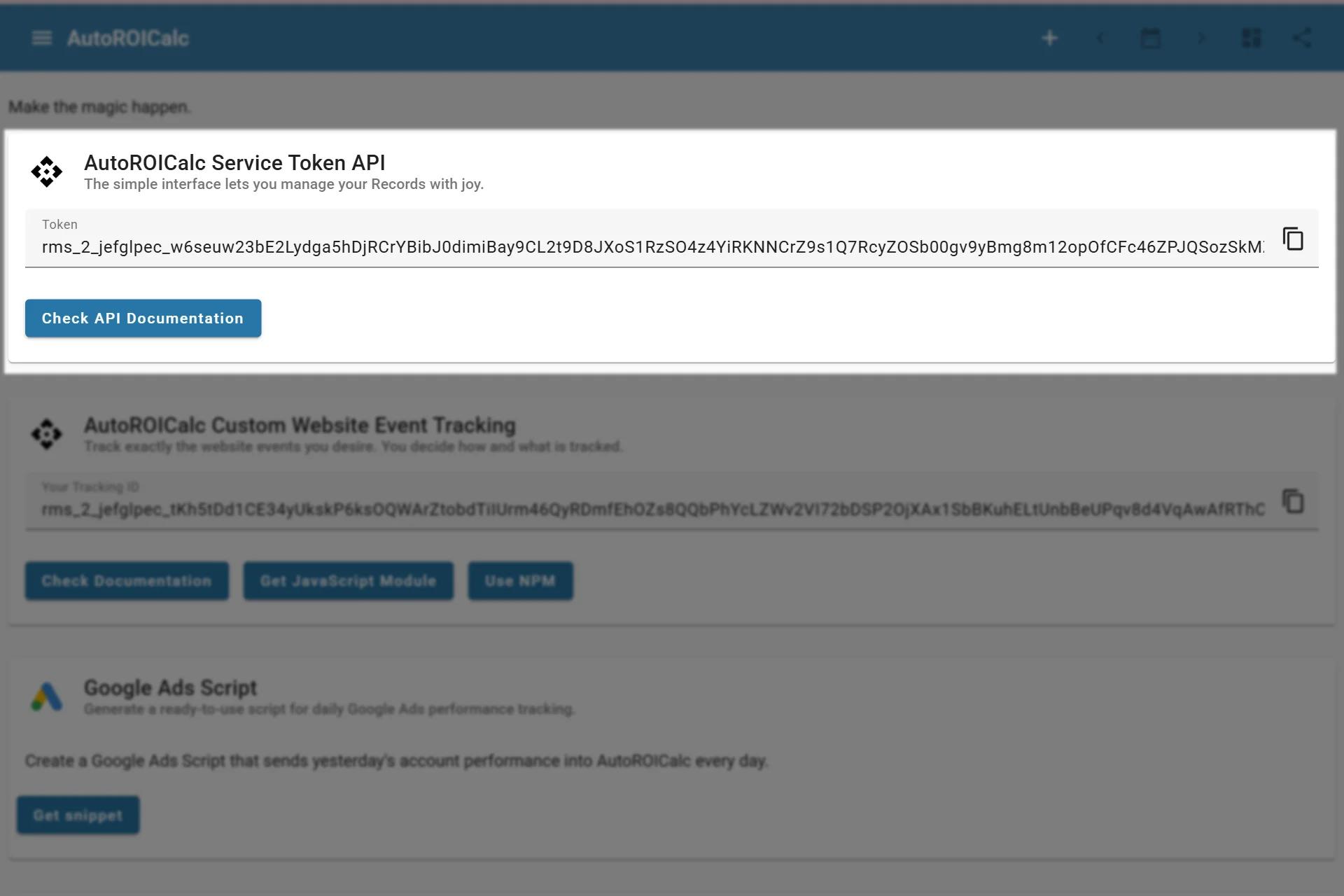
Finding the service token
Records API
Most custom integrations use the Records API to add records with fields such as type, description, date, source, tags, value, raw data, and custom data.
Records API Guide Records API Reference
Service Token Record Endpoints
Use service-token endpoints from trusted server-side code. The service token is passed as the service_token query parameter.
| Action | Endpoint | Purpose |
|---|---|---|
| Create one record | POST /service_token/record |
Adds a single record. |
| Create many records | POST /service_token/records |
Adds multiple records in one request. |
| Query records | POST /service_token/records/query |
Reads records with pagination and optional filters. |
| Update a record | PUT /service_token/record/{record_id} |
Updates an existing record by ID. |
| Get a report chart widget | GET /service_token/v1/reports/{report_id}/widgets/chart |
Returns widget HTML or a versioned JSON payload. |
Keep service-token calls server-side
Do not call service-token endpoints from browser JavaScript or public mobile app code. Query parameters can appear in logs, analytics, proxies, and browser history, so only use the service token from trusted backend code, scripts, jobs, or private automation.
Report Widget API
The Report Widget API can return a report chart to a trusted backend using the X-Service-Token header. The report must have authenticated or public widget access enabled.
Use the dedicated guide for access modes, HTML and JSON responses, public iframe embeds, and URL rotation.
Example Record Payload
The examples below create a record for a paid order. Adjust type, source, tags, value, custom_data, and raw_data to match your integration.
{
  "date": "2026-09-15",
  "time": "14:30:00",
  "type": "sale",
  "activity": "closed",
  "desc": "Order paid",
  "source": ["woocommerce"],
  "tags": ["ecommerce", "paid-order"],
  "value": 129.9,
  "custom_data": {
    "order_id": "100045",
    "customer_id": "8742",
    "campaign_id": "fall-2026"
  },
  "raw_data": {
    "provider": "woocommerce",
    "event": "order.paid"
  }
}
Create a Record Examples
curl -X POST "https://api.autoroicalc.com/service_token/record?service_token=$AUTOROICALC_SERVICE_TOKEN" \
  -H "Content-Type: application/json" \
  -d '{
    "date": "2026-09-15",
    "time": "14:30:00",
    "type": "sale",
    "activity": "closed",
    "desc": "Order paid",
    "source": ["woocommerce"],
    "tags": ["ecommerce", "paid-order"],
    "value": 129.9,
    "custom_data": {
      "order_id": "100045",
      "customer_id": "8742",
      "campaign_id": "fall-2026"
    },
    "raw_data": {
      "provider": "woocommerce",
      "event": "order.paid"
    }
  }'
<?php

$serviceToken = getenv('AUTOROICALC_SERVICE_TOKEN');
$url = 'https://api.autoroicalc.com/service_token/record?service_token=' . urlencode($serviceToken);

$record = [
    'date' => '2026-09-15',
    'time' => '14:30:00',
    'type' => 'sale',
    'activity' => 'closed',
    'desc' => 'Order paid',
    'source' => ['woocommerce'],
    'tags' => ['ecommerce', 'paid-order'],
    'value' => 129.9,
    'custom_data' => [
        'order_id' => '100045',
        'customer_id' => '8742',
        'campaign_id' => 'fall-2026',
    ],
    'raw_data' => [
        'provider' => 'woocommerce',
        'event' => 'order.paid',
    ],
];

$ch = curl_init($url);
curl_setopt_array($ch, [
    CURLOPT_POST => true,
    CURLOPT_HTTPHEADER => ['Content-Type: application/json'],
    CURLOPT_POSTFIELDS => json_encode($record),
    CURLOPT_RETURNTRANSFER => true,
]);

$response = curl_exec($ch);
$status = curl_getinfo($ch, CURLINFO_HTTP_CODE);
curl_close($ch);

if ($status < 200 || $status >= 300) {
    throw new RuntimeException('AutoROICalc request failed: ' . $response);
}

echo $response;
import os
import requests

service_token = os.environ["AUTOROICALC_SERVICE_TOKEN"]
url = "https://api.autoroicalc.com/service_token/record"

record = {
    "date": "2026-09-15",
    "time": "14:30:00",
    "type": "sale",
    "activity": "closed",
    "desc": "Order paid",
    "source": ["woocommerce"],
    "tags": ["ecommerce", "paid-order"],
    "value": 129.9,
    "custom_data": {
        "order_id": "100045",
        "customer_id": "8742",
        "campaign_id": "fall-2026",
    },
    "raw_data": {
        "provider": "woocommerce",
        "event": "order.paid",
    },
}

response = requests.post(
    url,
    params={"service_token": service_token},
    json=record,
    timeout=15,
)
response.raise_for_status()

print(response.json())
const serviceToken = process.env.AUTOROICALC_SERVICE_TOKEN;
const url = new URL("https://api.autoroicalc.com/service_token/record");
url.searchParams.set("service_token", serviceToken);

const record = {
  date: "2026-09-15",
  time: "14:30:00",
  type: "sale",
  activity: "closed",
  desc: "Order paid",
  source: ["woocommerce"],
  tags: ["ecommerce", "paid-order"],
  value: 129.9,
  custom_data: {
    order_id: "100045",
    customer_id: "8742",
    campaign_id: "fall-2026",
  },
  raw_data: {
    provider: "woocommerce",
    event: "order.paid",
  },
};

const response = await fetch(url, {
  method: "POST",
  headers: { "Content-Type": "application/json" },
  body: JSON.stringify(record),
});

if (!response.ok) {
  throw new Error(`AutoROICalc request failed: ${response.status} ${await response.text()}`);
}

console.log(await response.json());
#include <curl/curl.h>
#include <cstdlib>
#include <iostream>
#include <stdexcept>
#include <string>

int main() {
  const char* token = std::getenv("AUTOROICALC_SERVICE_TOKEN");
  if (!token) {
    throw std::runtime_error("AUTOROICALC_SERVICE_TOKEN is not set");
  }

  CURL* curl = curl_easy_init();
  if (!curl) {
    throw std::runtime_error("Could not initialize curl");
  }

  char* escapedToken = curl_easy_escape(curl, token, 0);
  std::string url = "https://api.autoroicalc.com/service_token/record?service_token=";
  url += escapedToken;
  curl_free(escapedToken);

  std::string payload = R"json({
    "date": "2026-09-15",
    "time": "14:30:00",
    "type": "sale",
    "activity": "closed",
    "desc": "Order paid",
    "source": ["woocommerce"],
    "tags": ["ecommerce", "paid-order"],
    "value": 129.9,
    "custom_data": {
      "order_id": "100045",
      "customer_id": "8742",
      "campaign_id": "fall-2026"
    },
    "raw_data": {
      "provider": "woocommerce",
      "event": "order.paid"
    }
  })json";

  struct curl_slist* headers = nullptr;
  headers = curl_slist_append(headers, "Content-Type: application/json");

  curl_easy_setopt(curl, CURLOPT_URL, url.c_str());
  curl_easy_setopt(curl, CURLOPT_HTTPHEADER, headers);
  curl_easy_setopt(curl, CURLOPT_POSTFIELDS, payload.c_str());

  CURLcode result = curl_easy_perform(curl);
  if (result != CURLE_OK) {
    std::cerr << "AutoROICalc request failed: " << curl_easy_strerror(result) << std::endl;
  }

  curl_slist_free_all(headers);
  curl_easy_cleanup(curl);
  return result == CURLE_OK ? 0 : 1;
}
Batch Records Example
Use POST /service_token/records when your integration can send several records at once. The request body is an array of record objects.
curl -X POST "https://api.autoroicalc.com/service_token/records?service_token=$AUTOROICALC_SERVICE_TOKEN" \
  -H "Content-Type: application/json" \
  -d '[
    {
      "date": "2026-09-15",
      "time": "14:30:00",
      "type": "sale",
      "activity": "closed",
      "desc": "Order paid",
      "source": ["woocommerce"],
      "tags": ["ecommerce"],
      "value": 129.9
    },
    {
      "date": "2026-09-15",
      "time": "15:10:00",
      "type": "lead",
      "activity": "open",
      "desc": "Pricing form submitted",
      "source": ["website"],
      "tags": ["lead", "pricing"],
      "value": 1
    }
  ]'